New Design: Piggy Banker!

Happy Halloween! Here is a very not spooky post. :)

I’ve been brainstorming for a while about a series of designs combining some of my favorite things: cute animals, little costumes, and… puns! Luckily, my mom is the absolute queen of puns and wordplay, so she has been helping me come up with a list of ideas that I am super excited about!

First idea on the list? A piggy banker!

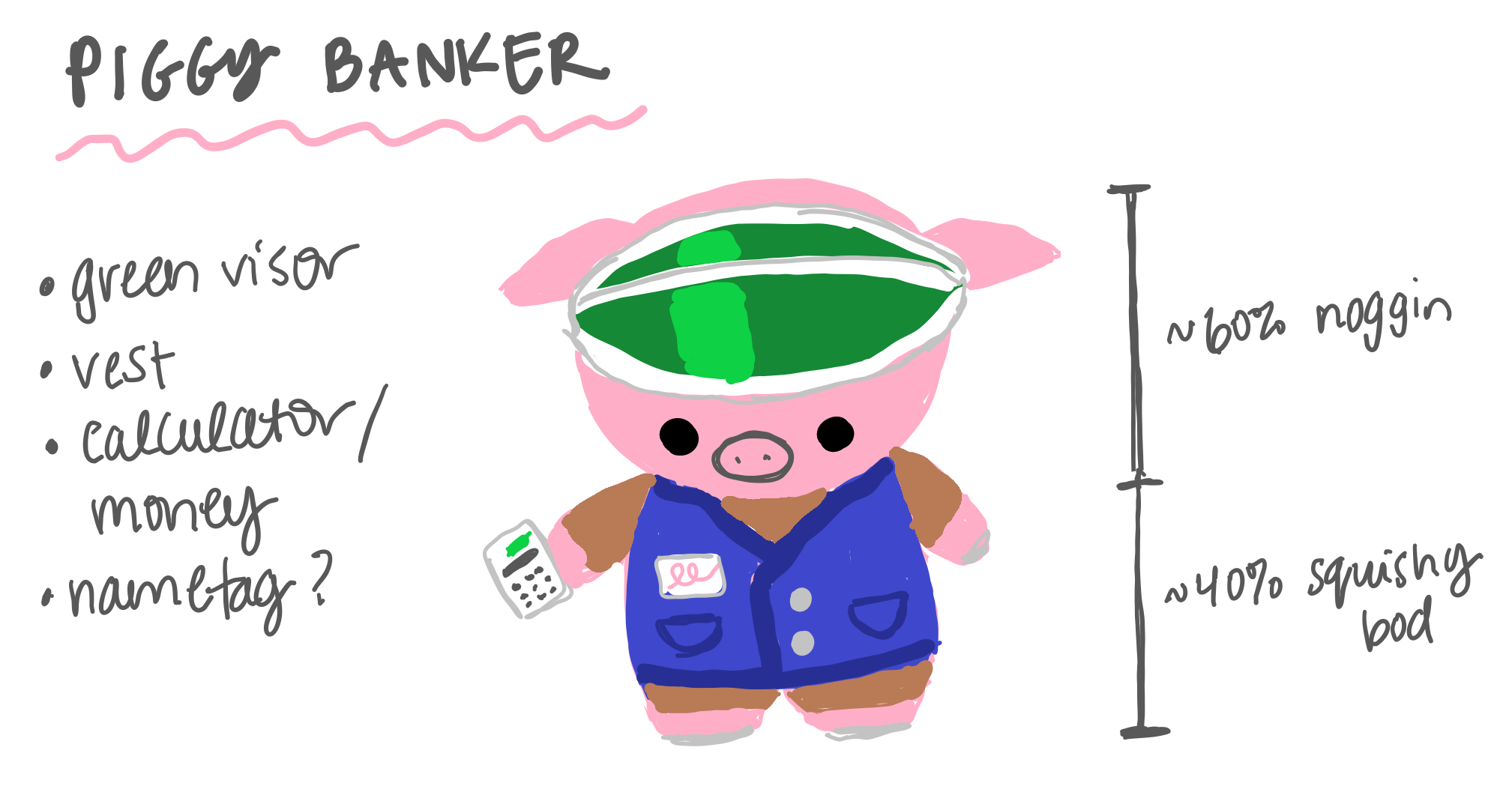
Here is one of my initial sketches:

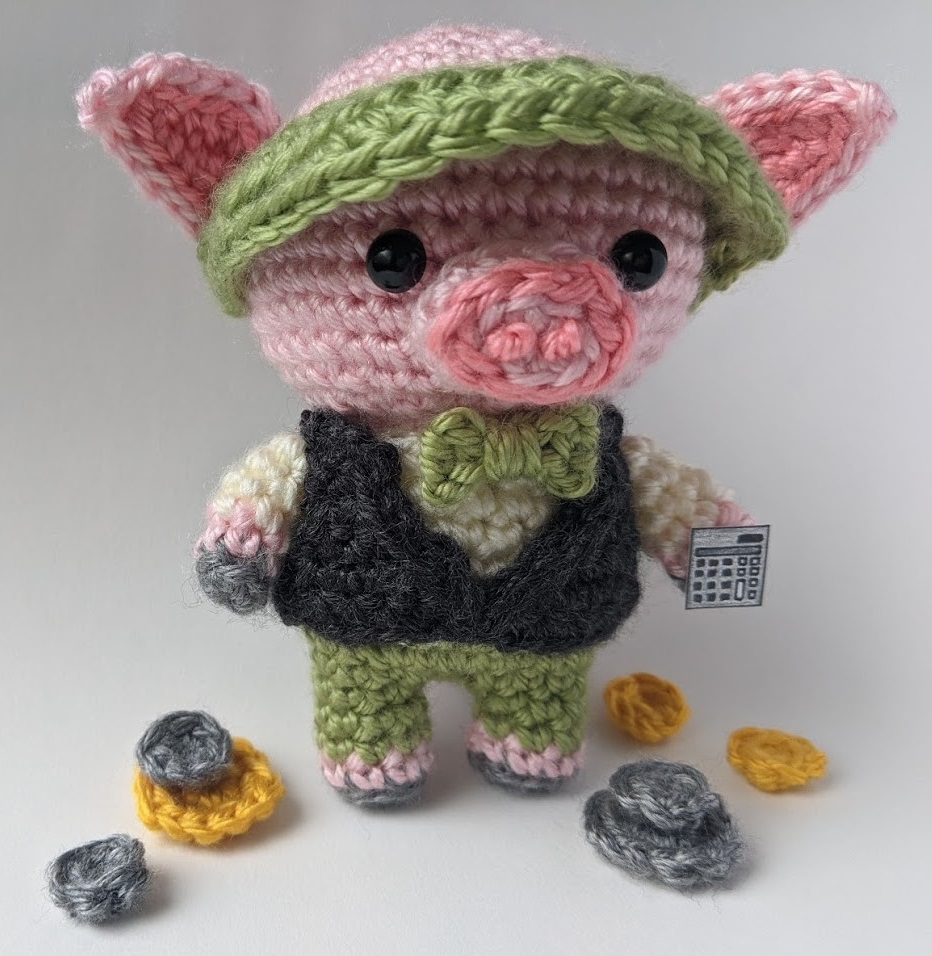
I personally like my cute items to be on the squishy/squat side, hence his big head and chubby little body. I went back and forth about the visor and did some research into accountant/banker visors, so you might notice that my actual design ended up looking a bit different to stay more true to the banker spirit (and less like a poker dealer). I also went with some different colors as well.

Here was my initial prototype!

After reflecting on him for a day or two, I compiled a bunch of changes that I wanted to make on my second attempt. I ended up being much happier with these adjustments! Here’s a comparison between the two designs:

Even though the differences between these two weren’t too significant, I think the end result was much cuter and more polished looking! I also made him some little coins and a small calculator to round everything out.

So, this is it for now! I’m waiting to get some new yarn to work up an official version (with maybe some additional minor changes), write out the pattern, and then I’ll get it posted to Etsy!

More punny animals to come!

Works in Progress

Happy weekend!

I’ve been doing this thing I told myself to stop doing, but always do anyway, which is having too many projects in progress and not really finishing any. :) So, here’s what’s been going on!

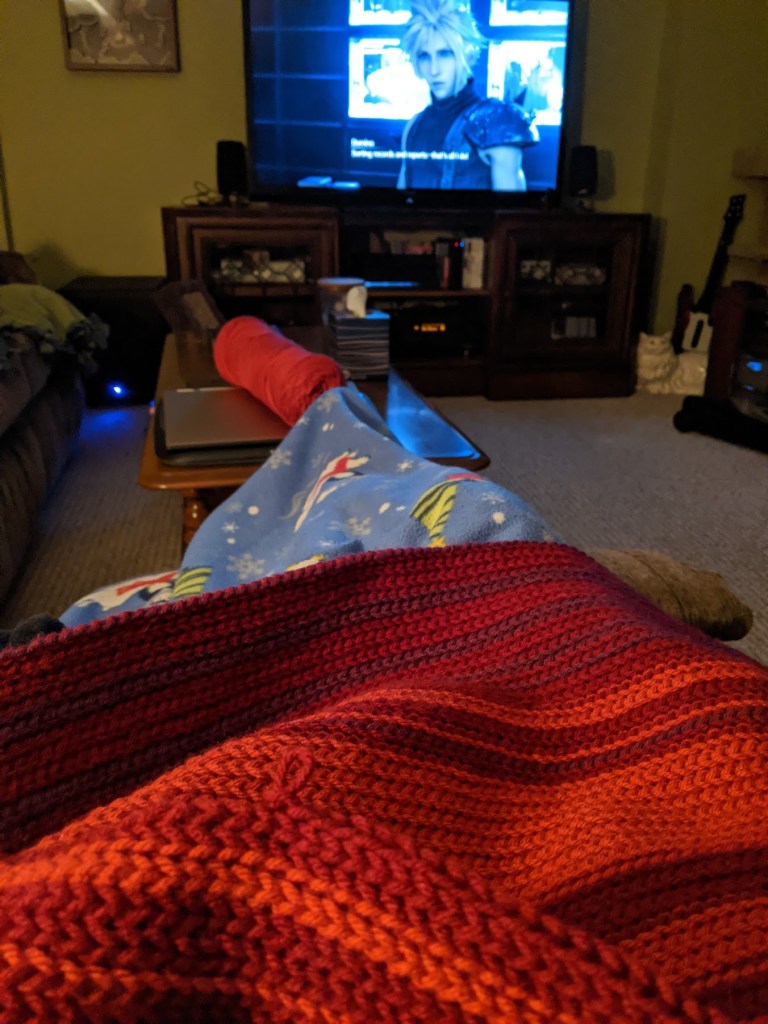
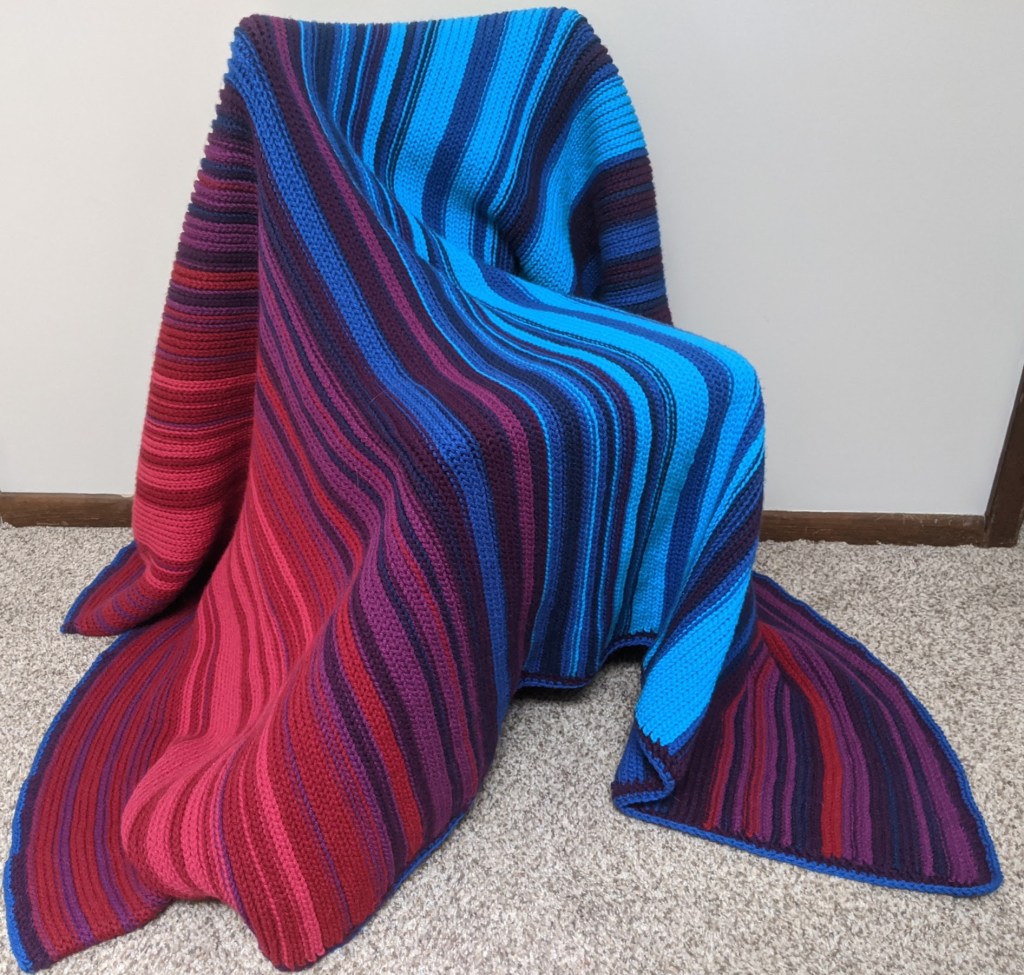
First up is my 2020 temperature blanket:

As I started this out, I actually really wasn’t happy with my choice of colors. I even considered starting over with a whole new color set. Luckily, I stubbornly kept going, and things are looking better as the warm colors are starting up. And yes, I’m far enough behind that I am just getting into the summer!

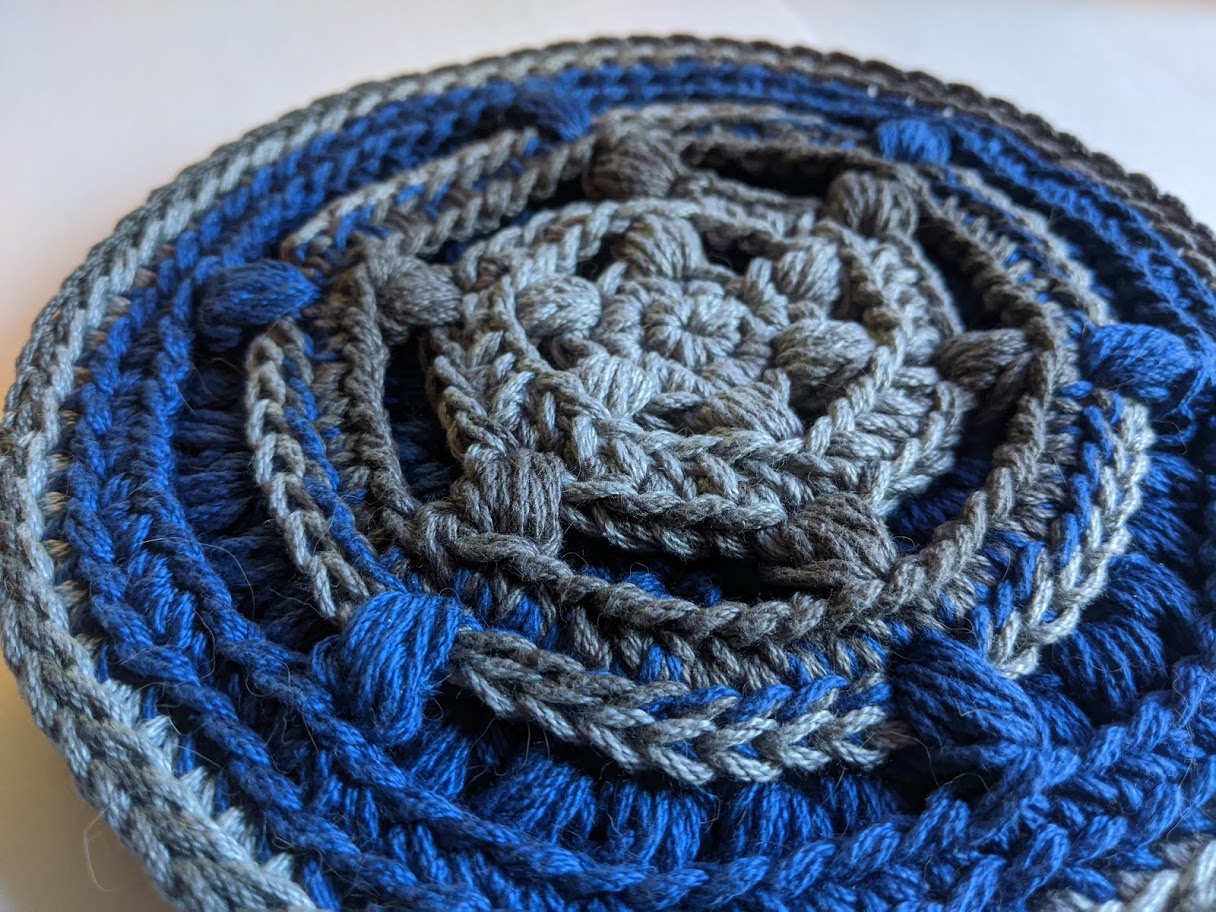
Next up is a hot pad design I’m working on for my mom’s pots & pans:

Her one request on these was: “blue and maybe grey or silver or something? And I want it to be a surprise”! I think I’ll work up a couple more design ideas before making a final choice.

And finally, here’s a little pig I’m working on for an amigurumi costume contest:

I’m really excited to get started on his costume! I have until October 21, so this is taking priority right now. :)

And finally, I don’t have anything to show for this right now, but I’m going to attempt some knitting… which I am just awful at! But I found a knit along on Instagram for a pair of socks and so I feel like maybe I can do it with some virtual company and encouragement!

Hopefully I’ll have something “complete” to share soon!

Anniversary Blanket

Well, this is awkward. Here it is, 2020, and the last post I made was in 2013. :) The last post occurred just before I started a very intense and stressful job. I’m in a better place now and am excited to bring this place back to life in my spare time!

I thought I’d start by posting a project that I recently worked on: a temperature blanket representing my parents’ first year of being married (they recently celebrated a milestone anniversary, so this was their gift).

I started out by gathering the high temperature for each day during the time period the blanket was going to represent. For this, I used The Old Farmers Almanac. This was a bit tedious but worth it for sure.

For the yarn, I ended up going with Caron’s “One Pound” acrylic yarn. The colors I chose (from left to right) were: Raspberry Wine, Claret, Hollyhock, Deep Violet, Midnight Blue, Royalty, and Blue Danube. I ended up getting pretty close to using all of the Claret and Deep Violet, but I had a bunch left over of every other color.

To plan things out, I made a little system in Excel which allowed me to “simulate” a virtual blanket based on the colors and temperature ranges that I selected. Here’s a screen capture of what this looked like: the “inputs” are in the upper left while the dynamic simulated blanket is in the bottom right.

The Excel system worked pretty well. It required just a few inputs after setting it up:

  • “Temp range size”: this is how many degrees (in Fahrenheit) I wanted each color to span.
  • “Lower / Upper temp bound”: this represents the bottom and top of each color’s temperature range. All of the black values are calculated automatically and are driven by the temp range size, the 106 and 11 degree values (the highest and lowest high temps occurring in the data), and the 39 degree value (chosen to limit how many of the lightest blue rows I ended up with).
  • Colors! You can’t really see it in the picture, but each row of the simulated blanket has a number (the high temp for that day), and then conditional formatting uses the lower and upper temp bounds to assign a fill color to that row. So for each color range, I just had to pick a representative fill color.

I played around with these inputs for a while until I liked how the simulated blanket looked. (I’m working on a “real time” temperature blanket for 2020, and it is a hot mess compared to this method!)

After I got my “pattern” settled, I busted out the yarn and hook and got to work! I started with about 200 chain stitches, and each row is entirely slip stitch (so that the blanket wouldn’t end up being insanely long). I always worked in the same direction – no turning the blanket, and I used a 6mm hook.

I will tell you that 366 rows of slip stitches wasn’t my favorite thing ever, but it was for a good cause. :) My husband was playing Final Fantasy VII Remake while I was working on this, which made for some good entertainment.

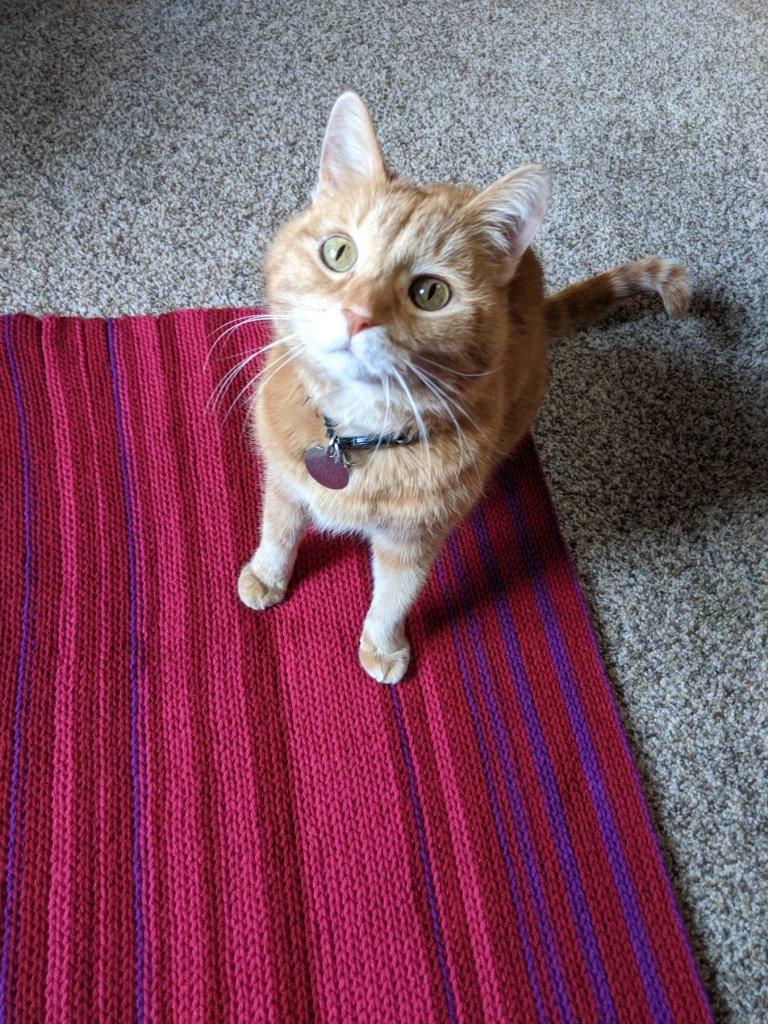
Of course, I couldn’t have done it without my trusty helper who was all too interested in testing the blanket-in-progress at all times.

And then finally… After sooo many slip stitches and a simple single crochet border… It was done!!

I ended up being generally happy with how it turned out. I like the colors quite a bit and the overall look of the stripes. One thing I regret a bit is that the blanket doesn’t drape as well as I would like. Turns out, my mom hangs it on her quilt rack and doesn’t really use it as a blanket anyway (“It’s too special!”).

Well, it feels good to be back online and sharing my projects with anyone who is interested! :) Hope you’re doing well in these strange times.

My First Sewing Project: A New Purse

For Christmas, my husband got me one of the most thoughtful and wonderful gifts ever; something I had wanted for a very long time. A sewing machine! I had never sewn before in my life, so I was sooo excited to start using it but so terrified of messing something up (mainly the sewing machine itself). After playing around with it a bit on some scraps of fabric, I decided my first project would be a new purse. First, a little story about my old rainbow purse:

I bought rainbow purse at Target for a bank breaking $9 in 2003, so I’ve had this thing for 10 years! This is the one purse I’ve had for these many years, so parting with it was a big decision. It’s just a purse, you say? Yes, a normal person would probably say so. But I have a small attachment problem… heh heh. Anyhow, this old purse will sit in my closet until I decide what to do with it.

After I decided I wanted to make a purse (but before I found a pattern I liked… maybe not the best decision, but it worked out), I picked out some fabric at Hobby Lobby. As I mentioned before, I looove grey. I especially love grey paired up with yellow. Surprisingly, Hobby Lobby had lots of grey & yellow fabric and I ended up deciding on the pattern above with some plain grey for the purse’s lining.

I looked around at (free) purse patterns for quite awhile before I decided on one – Rae’s Buttercup Bag. The pattern is so cute – I love the pleats! It’s also simple enough for somebody who’s never sewn something before.

I did decide on-the-go to make a few adjustments to Rae’s pattern: I added some metal rings where the straps attach to the body, an inner pocket, and some extra fabric around the edges to add some depth to the purse’s body.

You can see that this new purse has already gotten a little worn – the strap is wrinkled and folded. I’m not sure how to avoid this (any tips?), but it happened with rainbow purse too. Soon I’m going to try tackling a matching billfold, but right now it’s down the list a bit in terms of projects. Regardless, we’ll see if I hold onto this purse for 10 years, hehe!

Starting a New Project: Baby Boy Blanket

A sweet friend of mine is expecting a little boy in May, so I’m starting my next “middle sized” project today, something I’ve never made – a baby blanky! I looked up a bunch of patterns and tutorials, and eventually ended up deciding to design my own. I made a mini version last night which turned out well, so we’ll see how it does on a larger scale!

My friend isn’t planning on decorating baby boy’s nursery any specific colors, but gave me the rough guideline of “we like blues and greens.” So, perfect for me, my two favorite colors! I spent an embarrassingly long time in the yarn aisles at Hobby Lobby, combining blues, teals, greens, and greys. I initially really wanted to find a bright teal and pair it with a charcoal grey, but remembered that perhaps grey isn’t the most babyish of colors. Oops. And besides, not too many brands of yarn available at Hobby Lobby have a medium-dark grey… what’s up with that? All of that aside, I opted for “I Love This Yarn” antique teal, sea blue, and light sage.

Blues and greens (and secondarily, purples and greys) have been my color palette of choice for quite a long, long time. I specifically learning about analogous color schemes in elementary art class and immediately going for either “purple-blue-green” or “blue-green-yellow” combinations. In the last couple of years, grey has sneakily crept into my list of favorite colors. Everything looks fantastic with grey, I think. I’m afraid that my wardrobe is starting to get taken over – the clerk who very occasionally sells me a white chocolate truffle at work made the comment, “You really like grey, don’t you?” So I guess it’s no secret.

Anyhow, on to the blanket making. I’m thinking I should be able to be done within the week if I really stick to it at nighttime. We’ll see – updates to come!

Pattern & Tutorial: Crochet Tulip

We have a cute little vase sitting on a shelf in our bathroom – a cute, but empty vase. I knew I wanted to put something in it someday, but couldn’t put my finger on it yet. Then, it hit me (I don’t know why it didn’t sooner) to try crocheting some flowers. My most favoritest flower of all time is the tulip. It’s so smooth and squat – like a little teacup suspended on a stick! So cute! This past week I’ve been writing (and heavily revising) a tulip pattern, and here it is! Enjoy!

Materials You’ll Need
Crochet hook G (4.00 mm)
Worsted weight yarn color #1 for petals
Worsted weight yarn color #2 for pistil and stamen
Worsted weight yarn color #3 for stem and leaves
Scissors
Large eye needle
Floral wire of desired length
Ruler for making measurements
Sewing pins for positioning petals

Specific Materials I Used
Crochet hook G (4.00 mm) from Polymer Clay Shed
“I Love This Cotton” Pale Denim for petals
“I Love This Cotton” Banana for pistil and stamen
“I Love This Cotton” Sage for stem and leaves
Fiskars Scissors
Tapestry needle
18 gauge Hobby Lobby floral wire (not pictured)
Steel & cork ruler for making measurements
Sewing pins for positioning petals

Abbreviations Used (US terminology)
ch: chain
sc: single crochet
sc inc: single crochet increase
sc dec: single crochet decrease
Following each row’s instructions for the petals, the number in (parentheses) indicates how many stitches you should have in that row

Petal Pattern: Make 6
ch 2, ch 1 to turn (2)
sc in each, ch 1 to turn (2)
sc inc in each, ch 1 to turn (4)
sc inc, 2 sc, sc inc, ch 1 to turn (6)
sc inc, 4 sc, sc inc, ch 1 to turn (8)
sc in all, ch 1 to turn (8)
sc inc, 6 sc, sc inc, ch 1 to turn (10)
sc in all, ch 1 to turn (10)
sc dec, 8 sc, ch 1 to turn (9)
sc dec, 7 sc, ch 1 to turn (8)
sc dec, 6 sc, ch 1 to turn (7)
sc dec, 5 sc, ch 1 to turn (6)
sc dec, 4 sc, ch 1 to turn (5)
sc dec, 3 sc, ch 1 to turn (4)
sc dec, 2 sc, ch 1 to turn (3)
sc dec, 1 sc, ch 1 to turn (2)
sc dec, tie off leaving a 25 cm tail
Hide the short starting tail by sewing it in

After you have the six petals made, they should fit together like the above picture. Make sure all of the petals are facing the same way if you are particular about that kind of thing. :) Use one of the long petal tails to sew the very insides of the petals together.

Next, using each petal’s tail, sew the inner edges of each petal together to about 2 cm from the center. This is what will form the bottom of the “cup” shape of the tulip.

Now is the beginning of the tricky part. Decide how the petals will alternate – they need to go top-bottom-top-bottom-top-bottom (in other words, identify which petals will be inner and which will be outer). When you pull the tulip into its cup shape, the “top” petals will be in the inside and the “bottom” petals will be on the outside.

Pull the petals up and toward you and into the desired cup shape (you can determine how “open” you want the tulip to be here). You may have trouble holding everything in place with your hands, so pin the petals together and adjust the spacing as you like. As shown above, the edges of the widest part of my outer petals are about 1.3 cm apart. So if you’d like your tulip to be more “closed” than mine, pin your petals closer to each other. Likewise for a more open tulip, you would pin your petals farther apart from each other. Your tulip cup will look funny and lumpy when you pin it – don’t worry!

Now use all of the tails to sew the petals together. Try not to split any of the yarn of the petals as you do this, and make small stitches so they blend in with the crochet stitches. I sewed the petals up to where the inner and outer petal edges meet up, so the very top could fan out a bit without getting floppy. Now you should have a little tulip cup!

Next are the pistil and stamen. Get out your yarn color #2 and thread it on your needle. Pull the yarn up into the tulip cup in the desired spot, tie 2 or 3 knots in the yarn, cut off any excess, and pull the yarn back down through the bottom of the tulip cup until the pistil/stamen are the desired length. Cut off leaving a small tail. Repeat this for all pistil & stamen.

Now for the base and stem, so get out your yarn color #3. The base is a little disc shape. To make it, first ch 2, then make 6 sc in the first ch stitch. Then sc inc all the way around, so you should have 12 stitches in a little circle. Tie off and leave a 15 cm tail. Pull the starting tail tight, tie off and hide in the disc.

For the stem, decide on the length of stem you’d like and cut that much floral wire. The desired length will depend on personal opinion but also what container/vase you’ll be putting it in (if any). Make a chain approximately the length of the wire you chose. Turn at the end of the chain, sc down the entire row, turn, and sc down the entire row again (you should end up with 2 rows of sc on top of your chain). Tie off and leave a looong tail. Lay the floral wire on top of the strip you just made, and use the long stem tail to sew the strip shut around the wire.

Finally, you’ll use the base and stem tails to put everything together. Use the base tail to sew the base to the bottom of the tulip cup, hiding any color #2 yarn you used for the pistil and stamen. Now stick the floral wire partially through the center of the base/bottom of tulip cup (otherwise, the tulip cup can be floppy on top of stem), and use the stem tail to sew the stem to the base.

And that’s that! You should now have a full tulip! Please let me know if you have any questions about the pattern – I’d be glad to help!
A Quick Beaver Project

I think beavers are one of the neatest, cutest animals. So I spent the day writing and making a simple animal pattern – which, now that I’ve tried it out, I think I’ll try improving and adapting it to other animals as well. :)

The baby beaver in the picture above looks a bit like a squirrel or a chipmunk with its tail up, don’t you think? Eep! It’s a beaver, I swear! I didn’t realize until editing these photos that the baby’s tail does flip up a little bit. Must fix…

Anyway, I realized partway through sketching my ideas beforehand that I was settling on an image from when I was little: how my mom first taught me to draw animals (and how I often still do when I want to leave a quick message or doodle!). She taught me to draw a circle, draw the animal’s face and ears on the circle, and then add legs, arms, and a tail which appeared to float above the head/body. I also blame my love for “squat” things on this method of animal drawing – the squatter the animal, the better. In fact, maybe this is why I think beavers are so cute!

This design really makes for some simple crocheting. The body is a sphere-ish shape with a separately made flat base, and all the rest were details – little ears, arms, and legs (which were all the same shape), some big ol’ buck teeth of course, and a tail which is like a flattened, tapered tube.

I had a bit of trouble getting the beavers to sit flat. They don’t really want to, but I want them to! No amount of squishing them onto the table really helped, either. The bases were indeed flat circles when I made them, but my need to stuff my plushies to the hilt so that they’re firm puffed them out a little. I’m thinking about trying some backing on the base or something to keep it straight.

Apologies for the blatant white cat hair (or possibly scrap of polyfill?) on the nose in the picture above! Unfortunately, kitty hair finds its way onto everything unless I’m careful.

I ended up very happy with the baby beaver – she’s just the right size! I like the mama, too, but she looks a little bit too plain from the sides/top. I definitely would need to play around with the larger pattern some more to get the look I wanted.

All in all, a fun experiment! More animals to come!

Ongoing Project: Husband’s Ripple Blanket

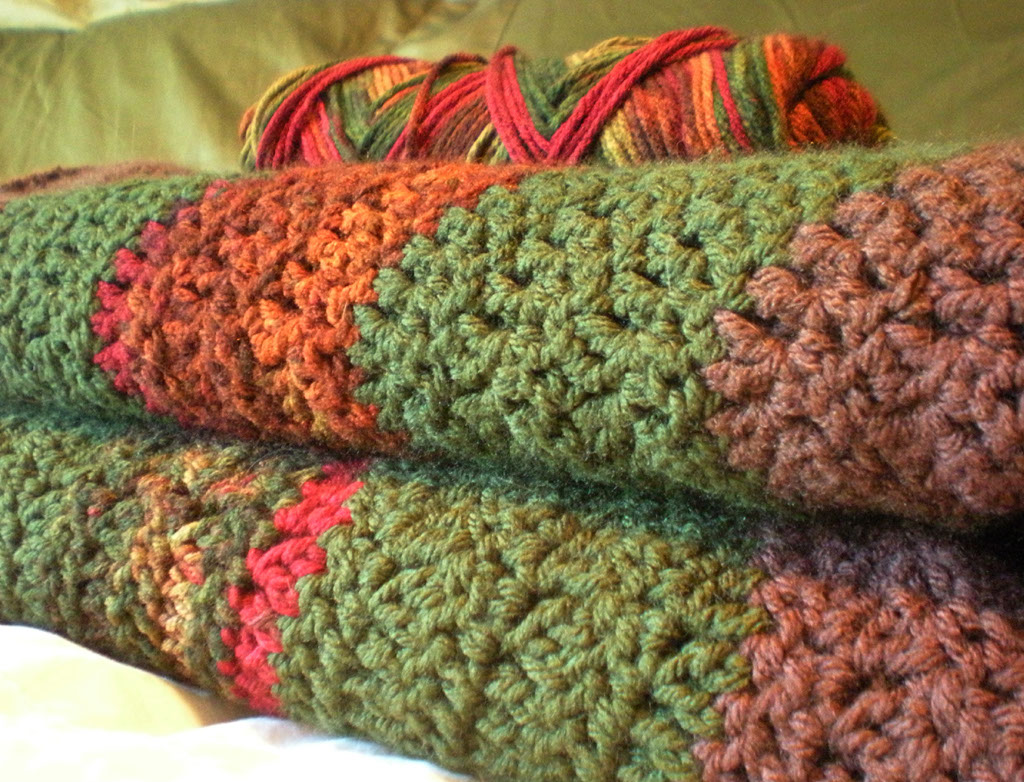
About a year and a half ago, I decided to undertake my first big crochet project: a blanket. My husband and I have some fluffy fleece blankies to cuddle up on the couch with, but they’re getting old, raggy, and pilly. So he and I took a trip to buy some blanket yarn, and he picked out all of the colors (thus making the blanket his): brown, green, and a variegated “autumn” mix of reds, oranges, yellows, and greens. I looove the combination of colors – greens and browns are some of my favorites, but the variegated yarn adds a little zip of brightness that the green and brown don’t have. Something I do get a little frustrated with, though, is when the variegation ends up giving me a giant blotch of all the same color. I almost ripped out several rows to get rid of such a blotch before my husband got all panicky and told me he likes the blotches. What?? Hey, it’s his blanket.

Look – you can see one of those big orange/brown blotches right there! They happen a lot more than I expected.

I was just getting “serious” into crochet at this the time of starting this, which coincided with me stumbling upon Lucy’s Neat Ripple Pattern. The simple pattern, the beautiful result, and the “quick” pace of creating a blanket appealed to me. So, off and on, some free time has been devoted to this big guy which my husband requires to be “big enough to wrap around me and make me cozy” – that’s a tall order.

Someday the blanket will be a piece of our living room (not our bedspread as pictured above – it’s just a convenient viewing area for the blanket as a whole!). I think I’m about halfway done with it, so we’ll see where I’m at another year from now! ;)

In the meantime, as you can see, the kitties bad kitty is already attracted. I swear, anything with potential loose ends and/or the potential to be coated with fur is like a magnet to him!

A Quick Owl Project

About a week ago, a good friend of mine sent me a cute photo of some little plushie owls with the message “I love owls!” Oooh, what a better excuse to come up with a cute owl pattern of my own to give to her?

I’m just starting to explore creating my own patterns – something that still intimidates me but is also really fun and exciting. I love being able to create something that starts as a whim, which grows into an idea and a sketch, and eventually becomes a (hopefully) cuddly little thing. Sometimes this ends up solely as a “learning experience” (AKA thing that doesn’t turn out quite right), but the owl wasn’t one of those. Phew! Good thing, because I saw this friend the next day for lunch and I was dying to present her with a cute little owl buddy.

I basically started crocheting two “body” parts, which you can see above in the not-so-great-quality photo I took with my phone. I used some leftover yarn that I’m using fairly heavily in a different and larger project – Aqua by “I Love this Cotton.” I really do love this brand of yarn; I feel like they almost always have the colors I’m looking for, the stitches come out looking nice and crisp, and the finished project is soft and flexible enough to be snuggly but sturdy enough to hold its shape.

After the two body parts, I made the eyes, beak, and breast fur from wool felt from Prairie Point Junction. If you haven’t browsed this website – go! I love it, and it’s where I order all my felt. I also made a “strip” to connect the two body pieces and give the owl some extra depth.

After all of that, applying some safety eyes, filling the owl with some pellets & stuffing, and sewing her up, the finished owl emerged…

I’m pretty happy with her! You can see that I opted to not include the wings that were in my original sketch – partially because of time constraints and partially because I couldn’t decide on the best approach (felt? crochet? what colors?). The felt breast is a little crooked, and the hand sewing took a bit of tedious time, but overall she turned out how I had imagined! I had a hard time giving her up the next day… :)